
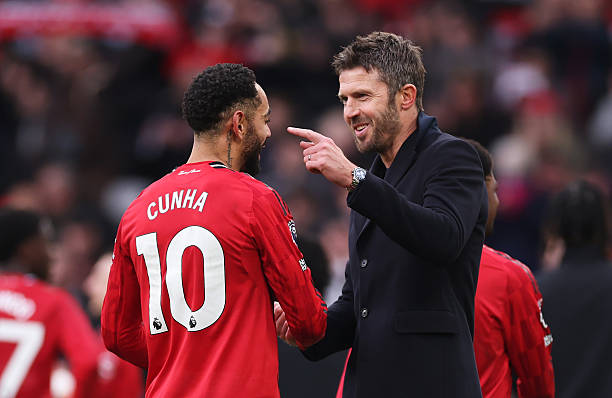
Michael Carrick’s early spell in charge of Manchester United has offered a glimpse of stability during a turbulent period for the club. Calm on the touchline and measured in his approach, the former United midfielder has overseen a run of performances that suggest the squad has responded positively to his leadership. However, while the initial signs have been encouraging, the real examination of Carrick’s credentials is only just beginning.
Stepping into a high-pressure environment, Carrick inherited a team short on confidence and clarity. His immediate priority was to restore balance, both tactically and mentally. United’s recent displays have reflected that focus, with improved organisation, greater discipline off the ball, and a clearer structure in midfield. These changes, though subtle, have helped the team regain composure and control in key moments.
Carrick’s understanding of the club’s identity has also played a role. A product of United’s most successful modern era, he brings institutional knowledge that resonates within the dressing room. His emphasis on simplicity—keeping possession, maintaining positional discipline, and trusting experienced players—has allowed the squad to reset without the disruption of wholesale tactical changes.
Yet, early momentum can be deceptive at a club of Manchester United’s stature. The upcoming run of fixtures is expected to present a far sterner test, with stronger opponents and less margin for error. Sustaining progress against elite competition will require more than organisation; it will demand consistency, adaptability, and decisive in-game management.
One of the key challenges Carrick faces is squad depth and rotation. As fixture congestion increases, managing player workload while maintaining performance levels will be critical. Injuries, fatigue, and form fluctuations have derailed United in previous seasons, and how Carrick navigates these issues could define the success or limitations of his tenure.
There is also the question of attacking efficiency. While defensive stability has improved, United must show greater sharpness in the final third. Creating chances consistently and converting them against top-level opposition remains an area that will come under scrutiny. Carrick’s ability to refine the team’s attacking patterns without compromising defensive structure will be closely watched.
Beyond the pitch, external expectations continue to loom large. Manchester United is a club where short-term results often overshadow long-term planning. Carrick’s calm demeanour has been an asset so far, but sustained pressure from media, supporters, and internal decision-makers is inevitable. How he handles those demands may prove just as important as his tactical decisions.
Importantly, Carrick himself has remained grounded, consistently downplaying individual praise and redirecting focus toward collective improvement. This measured approach has helped steady the narrative around the club, at least temporarily. However, football at the highest level is relentless, and reputations are shaped quickly by results rather than intent.
As United move into this defining phase, the context around Carrick’s role will become clearer. Whether he is viewed as a long-term solution or a steadying influence during transition may depend on how the team performs when the challenges intensify.
For now, the early signs are positive. Manchester United appear more cohesive, more controlled, and more purposeful. But the coming weeks will determine whether this promising start is the foundation of something sustainable or simply a brief moment of calm before tougher realities set in. For Michael Carrick, the biggest test is no longer theoretical—it is unfolding in real time.